SOFT BLADE
Somya Desai
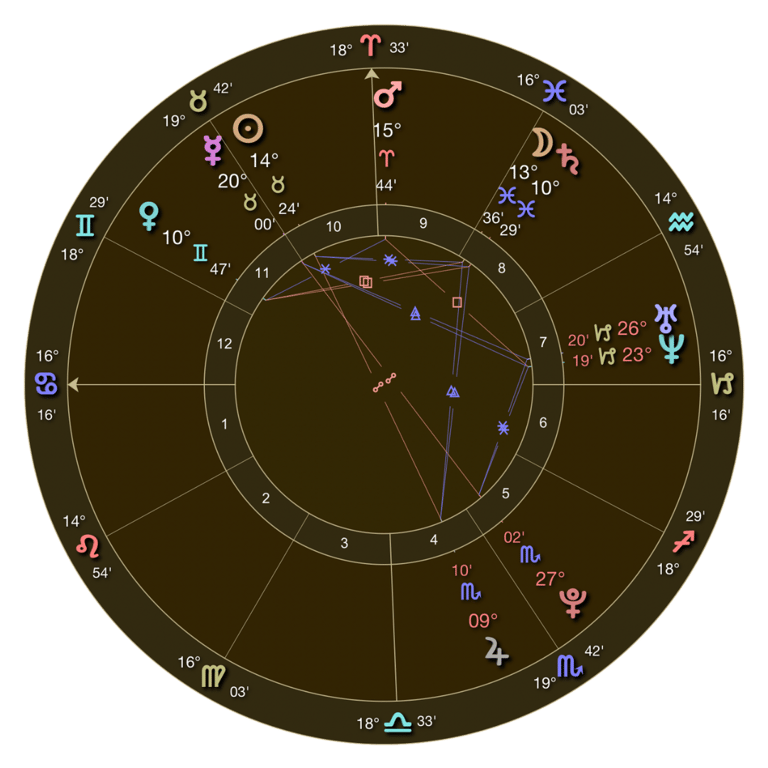
Born on May 5, 1994, at 11:22 AM in Singapore, Singapore
YOUR MYTH
Core Essence

The Soft Blade is grace under tension.
A cut made clean.
A gleam held close.
She does not shout—she sharpens.
She does not chase—she chooses.
Forged in brilliance,
tempered by pressure,
veiled in beauty,
she carries all three.
Where others overflow, she refines.
Where others seek the stage,
she becomes the frame.
Her ache is private.
Her reach is holy.
Her silence is not absence—
it is design.
She was not built to perform.
She was carved to last.
The Soft Blade was not born polished—
she honed herself.
Through rigor.
Through restraint.
Through love that learned to wait.
She does not cut to harm.
She cuts to clarify.
And in the quiet of that edge—
she makes something eternal.
The Symbol

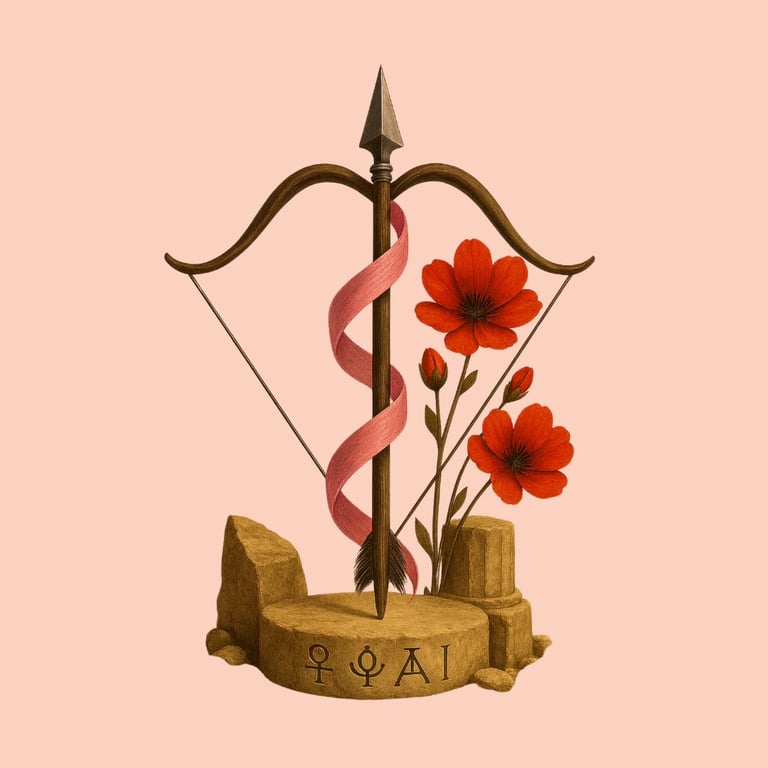
The Blade of Discernment
Fixed in the earth yet reaching upward, the sword stands not for conquest, but for clarity. It carves through confusion, not with force, but with focus—its stillness more powerful than motion.

The Ruins of Initiation
The fractured columns beneath recall what has crumbled—and what remains. They are the remnants of former selves, now a foundation for a vow renewed in silence.

The Ribbon of Grace
Winding gently around the blade, the blush ribbon is restraint made visible. It softens what could cut, transforming discipline into devotion, and will into beauty.

The Ember of Insight
Where steel meets stone, a soft light gathers—not to dazzle, but to reveal. Illumination born from contact with the real.

The Blossoms of Longing
Rising beside the blade, these red flowers bloom from ache. They speak of a heart that’s felt too much—and made art of it. In their fragility lives a fierce form of strength.

The Glyphs in Stone
Etched into ruin, the glyphs remember what words forget. Symbols of survival, carved in silence.
Mythic Mantra
I was not made to dazzle—I was made to endure with elegance.To thread sorrow into structure,to wield clarity without cruelty,to soften the edge without losing the point.I bloom where stone has cracked.I bow, but I do not break.My strength is not in volume,but in precision.Not in spectacle,but in sovereignty.I walk the blade between beauty and burden,between silence and expression.Every choice is a vow.Every movement, a myth.I rise, not to be seen—but to become.I live as the blade wrapped in blush,the rose carved from winter,the softness that survives.I am Soft Blade.And I shape the world with quiet power.
ASPECTS EXPLORED

RADIANT REACH
SUN opposite JUPITER
☉ ☍ ♃
A Sun–Jupiter opposition gives rise to the Radiant Reach—a soul stretched between self and sky, where brilliance seeks breadth and meaning meets magnitude. This is the alignment of someone who does not simply shine, but hungers to illuminate the world. The Sun offers identity, Jupiter expands it—and together, they forge a being who reaches toward the infinite, chasing purpose across every domain.
The Radiant Reach does not dim. She expands. Her spirit moves like sunlight breaking through cloud—wide, golden, insistent. This archetype lives in the tension between gift and grandeur, between devotion and ego. She is born to inspire, but must learn not to burn. Her challenge is not ambition, but orientation—learning to serve the light rather than become it, until every act of self-expression becomes an offering, and every vision becomes a compass for the collective.
- Person: Ralph Lauren
- Activity: Night Running
- Film: There Will Be Blood
- Aesthetic: Apex Predator

WINTER ROSE
SATURN conjunct MOON square VENUS
☽ ☌ ♄ □♀
A Moon–Saturn conjunction squared by Venus gives rise to the Winter Rose—a soul formed in frost, where softness is preserved through strength, and love matures beneath silence. This is the alignment of someone who does not just feel, but learns to protect what is beautiful. The Moon gives sensitivity, Saturn gives boundaries, and Venus—pressed between them—longs to bloom, but fears the cold.
The Winter Rose does not open easily. She holds her petals close, her dreams even closer. Her creativity is precise, restrained—shaped by longing and the ache to get it right. She has felt the chill of emotional absence, and now tends to herself like a fragile stem in snow. And yet, inside her stillness lives a quiet devotion. Her challenge is not expression, but permission—to let beauty out before it feels complete. For in her guarded blossoming lies a kind of grace the spring could never teach: the courage to unfold anyway.
- Person: Audrey Hepburn
- Activity: Sensory Deprivation Floating
- Film: The Green Mile
- Aesthetic: Wounded Healer

UNDERWORLD CURATOR
MERCURY opposite PLUTO
☿️ ☍ ♇
A Mercury–Pluto opposition gives rise to the Underworld Curator—a mind built for excavation, a voice shaped by silence. This is the alignment of someone who does not simply speak, but selects what must be preserved. Mercury gives language, Pluto gives depth—and together, they forge a being who listens beneath the surface and organizes the shadows into meaning.
The Underworld Curator is not loud. She is precise. Her thoughts are not scattered—they are archived, each one chosen, placed, refined. She doesn’t chase truth. She collects it. Edits it. Frames it with care. Her mind is not a battlefield—it is a gallery. And what she reveals carries weight, because it comes from what others refuse to see.
Her challenge is not perception, but trust: knowing when to share what she sees, and how to do so without shattering the frame. For when her voice is guided by devotion, not domination, she becomes more than a witness—she becomes the keeper of insight. A librarian of the unseen. A steward of psychic inheritance.
- Person: Carl Sagan
- Activity: Bonsai Pruning
- Film: A Hidden Life
- Aesthetic: Quiet Centurion
RADIANT REACH
SUN opposite JUPITER
☉ ☍ ♃
Benjamin Franklin (January 17, 1706) didn’t inherit a throne—but he built a world.
He was born the fifteenth child of a candle maker, apprenticed to his brother’s printing press, and ran away at seventeen with barely more than a vision in his mind. There was no obvious path to greatness. But Franklin didn’t wait for permission—he published himself into public life.
What set him apart wasn’t just intelligence—it was breadth. He moved between science, philosophy, diplomacy, and commerce with ease. Invented the lightning rod. Organized the first public library. Drafted the Declaration. Charted the Gulf Stream. And through it all, he remained curious—not just about how the world works, but how it could work.
He wasn’t chasing glory. He was designing infrastructure for imagination.
At the center of his chart is a Sun–Jupiter opposition—what we call The Radiant Reach. The Sun gives vision. Jupiter gives expansion. But in opposition, they create tension: the desire to shine and to serve, to express and to uplift. For Franklin, this showed up as civic mythmaking. Not ego—but elevation. Not just personal success—but public enlightenment.
He didn’t ascend through dominance.
He expanded through ideas.
And in doing so, he turned thought into policy.
Curiosity into contribution.
Renaissance into Republic.
His story reminds us:
That wisdom doesn’t have to retreat into books.
That ambition can be generous.
And that when you shine on behalf of something greater, your reach becomes a bridge—not a crown.
Skyward Stretch reflects the ascending clarity of the Sun–Jupiter opposition, where expansion is earned through grounded elevation. This is not a stretch of sinew—it’s a stretch of spirit.
The arms don’t reach to control—but to commune. The spine rises like a question, not a command.
You stand in stillness, but something moves:
a longing, a lucidity, a lift.
The body becomes a vessel for belief—
not in what is, but in what could be.
Sun brings presence. Jupiter brings vision.
Together, they create a vertical devotion.
A discipline of aspiration.
You are not striving—you are attuning.
Each morning, a ceremony of vertical grace.
Where other movements push, Skyward Stretch opens.
You don’t dominate space—you collaborate with it.
The posture becomes prayer.
And in that quiet reach, something sacred answers.
It is not about effort.
It is about alignment.
Stretch not to grasp—but to greet the possible.Let your breath rise like sunlight. Let your reach remember the sky.

In Dead Poets Society (1989), the Sun–Jupiter opposition burns through Mr. Keating—an educator who doesn’t just teach poetry, but awakens soul. Where the Sun seeks to shine and Jupiter seeks to expand, Keating becomes a vessel of illumination: not through control, but through invitation. He doesn’t command greatness—he evokes it.
His classroom is a chapel. His words, a spark. He dares his students to think, to feel, to live—to tear up the map and draw a new one from within. But the very expansiveness he embodies becomes dangerous in a world built on order and expectation. He lights a fire in the young, but the world isn’t ready for their radiance.
The opposition here is not within Keating, but between truth and system. Between the voice that says carpe diem, and the silence demanded by authority. Between the inner flame and outer obedience.
This is Radiant Reach as rebellion: not loud, not violent—but true. A reach not for status, but for soul. The cost is real. The ache is deep. But the myth is eternal.
Dead Poets Society reminds us what this alignment carries at its core: that the purpose of light is not just to shine—but to wake others up. That a life lived fully is a risk. And that sometimes, the most powerful revolution begins with a whisper:
“O Captain, my Captain.”
WINTER ROSE
SATURN conjunct MOON square VENUS
☽ ☌ ♄ □♀
Elisabeth of Austria (December 24, 1837) was born into nobility—but she never truly belonged to the court that crowned her.
Known as Sisi, she became one of the most admired women in 19th-century Europe—idolized for her beauty, her elegance, her mythic aura. But behind the portraits was a woman unraveling. She mourned her children, withdrew from public life, and wandered across Europe in search of silence, poetry, and air.
She hated court protocol. Hated being watched. And yet, she was obsessed with maintaining the image of perfection—measuring her waist daily, preserving an identity that never quite felt like her own.
But Elisabeth didn’t collapse. She disappeared. Not in weakness, but in self-preservation. Her withdrawal wasn’t retreat—it was refinement. A way to keep something sacred untouched. In time, she became more than a woman. She became a myth.
At the center of her chart is a Moon–Saturn conjunction square Venus—what we call The Winter Rose. The Moon offers sensitivity. Saturn imposes silence. Venus longs for connection—but it comes under pressure. The result is beauty wrapped in restraint, emotion carved into form. It’s not easy love—it’s enduring love. Not spontaneous art—but curated devotion.
Elisabeth didn’t perform for the world.
She let the world imagine her.
And in doing so, she turned longing into legend.
Her story reminds us:
That not all flowers bloom in spring.
That distance can be its own form of power.
And that the most sacred beauty is sometimes the one kept untouched.
The ache does not always cry out—
sometimes, it arranges itself into beauty.
sometimes, it arranges itself into beauty.
To press a flower is to listen to time. To slow enough to catch the final breath of something fleeting—and cradle it into permanence. Each bloom, a memory. Each page, a quiet reliquary. This is not nostalgia. This is devotion in form.
The Venus–Moon–Saturn alignment longs not to escape emotion, but to give it shape. This is the grace of containment—not repression, but reverence. You are not writing to remember. You are remembering to feel. Each petal flattened is a gesture of stillness. Each tape, each note, a small ceremony of care.
You don’t seek to fix the past.
You seek to hold it gently.
To archive sorrow without bitterness.
To trace beauty even in decay.
This journal is not loud.
It will never go viral.
But it will glow in a drawer for decades—
like a heart that dared to remain soft,
even when the world turned cold.
Press not to preserve what’s dying—but to witness what was once fully alive.Let form become your prayer.Let quiet become your protest.Let this be your way of loving what you could not keep.
In Phantom Thread (2017), the Moon–Saturn square Venus emerges not in outbursts—but in tight stitches, silent rooms, and the unbearable discipline of beauty. Reynolds Woodcock lives in a world carved by control: every pleat perfect, every breakfast silent, every emotion tailored and tucked away. Love is not ease—it is intrusion. And yet, he longs for it.
Winter Rose breathes in this tension—between romance and rigor, touch and distance, craving and constraint. Reynolds doesn’t chase love; he curates it. He shapes it into silence, into structure. And Alma, in her own quiet defiance, meets him not with submission, but with subtle rebellion. Love here is not sweet. It is sculpted. Poisoned. Persevered.
This is not a story of falling in love.
It’s a story of constructing it—out of absence, need, and impossible standards.
The Moon–Saturn alignment builds walls to protect the heart, while Venus waits, bruised, behind them. In Phantom Thread, that architecture is literal. Dresses become shields. Ritual becomes refuge. And yet, love finds a way—not through words or warmth, but through surrender to something stranger. Something shaped.
Phantom Thread is the shadow and splendor of Winter Rose: that when love enters the house of discipline, it does not soften it—it haunts it. And only through haunting does it endure.
UNDERWORLD CURATOR
MERCURY opposite PLUTO
☿️ ☍ ♇
Lorenzo de’ Medici (January 1, 1449) didn’t rule by decree—he curated a civilization.
Known as Lorenzo the Magnificent, he was not just a political figure, but a living myth—a poet, philosopher, and strategist who understood that power was not about domination, but design. He didn’t shout. He selected. He placed people, funded visionaries, and shaped Florence as if arranging a gallery—each choice quiet, deliberate, irreversible.
His court became the cradle of the Renaissance—not by accident, but by intellect. Lorenzo knew how to read the undercurrents of politics, the psychology of rivals, the meaning behind silence. He was not flamboyant. He was precise.
At the center of his chart is a Mercury–Pluto opposition—what we call The Underworld Curator. Mercury speaks. Pluto senses. Together, they form a mind that listens below the surface, gathers meaning from shadows, and preserves only what endures. This isn’t the voice of confession—it’s the hand that decides what history remembers.
Lorenzo didn’t interrogate with force.
He curated with foresight.
His story reminds us:
That legacy is built in silence.
That power doesn’t always announce itself.
And that when you gather the right truths, the world eventually bends around them.
To follow the thread is to enter the labyrinth.
This is not a vision board—it is a reckoning.
A private investigation. A ritual of meaning-making where ink becomes blood, and string becomes spell.
With hands steady and eyes sharp, you gather fragments:
a headline, a handwritten note, a quote that won’t leave you alone.
You do not ask what they mean—you ask what they’re hiding.
Each line you draw is a connection,
but also a cut—slicing into surface stories, revealing what lies beneath.
This is the logic of myth and map, of symbol and system.
A mind made visible.
You aren’t building a theory.
You are summoning a pattern.
One that remembers before it explains.
One that feels before it knows.
Here, Mercury descends.
And Pluto opens the archive.
Map not to control, but to uncover.Trace what resists erasure.Let the red thread become your lens—your question, your blade,your compass through the unseen.
In Arrival (2016), the Mercury–Pluto opposition finds its voice in Louise Banks, a linguist called not to conquer the unknown—but to comprehend it.
She does not fight her way into meaning. She listens. She watches. She waits.
Louise is the Underworld Curator—one who descends into the depths not with armor, but with language. Her journey is not heroic in the traditional sense; it is internal, quiet, intimate. She does not seek to solve, but to understand. And through that understanding, something cosmic unfolds.
Time collapses. Memory reshapes. Emotion becomes knowledge. Her work is not just translation—it is initiation.
To speak with the other, she must surrender certainty. To make contact, she must enter grief. Louise learns to carry loss, not as a wound, but as a container—an opening through which greater meaning can flow.
The Mercury–Pluto archetype here is not aggressive—it is transformative. Not the detective interrogating from across the table, but the oracle decoding symbols in the dark. She teaches us that inquiry is sacred, that language is a threshold, and that truth, when uncovered with tenderness, can change the entire shape of reality.
Arrival does not glorify knowledge for its own sake—it honors knowledge that heals. Knowledge that sees. Knowledge that remembers.
Louise does not emerge victorious.
She emerges initiated.
AESTHETICS
Color Palette

Blush Vow
A petal-soft blush touched by morning light. It whispers of innocence preserved through pain—a tenderness that refuses to harden, even when the world grows cold.
A petal-soft blush touched by morning light. It whispers of innocence preserved through pain—a tenderness that refuses to harden, even when the world grows cold.

Temple Dust
The faded brown of crumbled sanctuaries and ancient stone. It carries the weight of what has endured—beauty aged, not broken, grounded in memory and ritual.
The faded brown of crumbled sanctuaries and ancient stone. It carries the weight of what has endured—beauty aged, not broken, grounded in memory and ritual.

Nocturne Ink
An absolute black, like ink pressed into parchment or night before the storm. It holds depth without chaos—a silence that listens, a void that shapes.
An absolute black, like ink pressed into parchment or night before the storm. It holds depth without chaos—a silence that listens, a void that shapes.

Bloodlit Oath
A deep, ancestral red that burns without brightness. It calls forth devotion, danger, and dignity—an oath not spoken, but sealed.
A deep, ancestral red that burns without brightness. It calls forth devotion, danger, and dignity—an oath not spoken, but sealed.
Winter Petal
A vivid bloom against the frost—resilient, feminine, and alive. It holds contradiction like a secret: delicate yet daring, romantic yet untamed.
A vivid bloom against the frost—resilient, feminine, and alive. It holds contradiction like a secret: delicate yet daring, romantic yet untamed.
Style Guide
Integrated Vision
HISTORY
1987
The world when you were born.

♄ ☌ ♅ Saturn conjunct Uranus
A supportive aspect that bridges tradition and innovation. Saturn, the architect of order and enduring structure, aligns with Uranus, the awakener and disruptor of norms. This alignment reflects a time when change is not rebellious but constructive—when the new honors the old by transforming it from within. Breakthroughs are made with blueprints, revolutions guided by responsibility. It’s the rebel in a tailored suit, the inventor who respects history, the patient reformer.
Yet the tension of this harmony can manifest as quiet repression—a fear of moving too fast, or of destabilizing hard-won stability. It may reflect stalled progress, an over-rationalization of freedom, or creativity that calcifies into systems before it fully breathes. Still, when harnessed, it carries the power to reshape reality through thoughtful disruption and enduring reform.
♃ □ ♅ Jupiter square Uranus
A tense alignment that electrifies the drive for expansion. Jupiter, the planet of growth, vision, and belief, collides with Uranus, the radical force of disruption and awakening. This aspect reflects a restless hunger for freedom—intellectual, spiritual, and cultural. It surges with rebellious optimism, grand schemes, and sudden leaps of insight. Innovation feels urgent. Rules feel irrelevant. Life wants to be lived on a larger scale, and on your own terms.
But the square stirs friction. It can manifest as overconfidence, erratic risk-taking, or a relentless need to escape the ordinary. Ideals may outpace reality. Revolutions may burn out before they build. There’s a danger of mistaking impulsiveness for truth, or novelty for wisdom. And yet, when channeled with awareness, this alignment fuels breakthroughs of vision—expanding what’s possible and jolting stagnant systems into unexpected evolution.

♃ □ ♆ Jupiter square Neptune
A tense dialogue between belief and illusion. Jupiter seeks meaning and expansion; Neptune dissolves boundaries in dreams and ideals. Together in square, they swell with spiritual longing—but risk confusion, overreach, or blind faith. This alignment can inspire grand visions unmoored from reality, or cloak escapism in the language of hope.
It’s the spell of the utopian promise, the lure of the mirage. Morality may become abstract, truth slippery. But beneath the fog lies a deeper invitation: to refine faith through disillusionment, and to anchor vision in discernment. When illusions fall, a more mature compassion can rise—one that dreams, yes, but also endures.